

The Premier League Sack Race: All 20 Managers Ranked
Every Premier League manager, ranked by his chance of leaving before the season ends. "Leaving" means sacked or out by mutual consent - the two are the same thing dressed differently, and the model treats them that way.
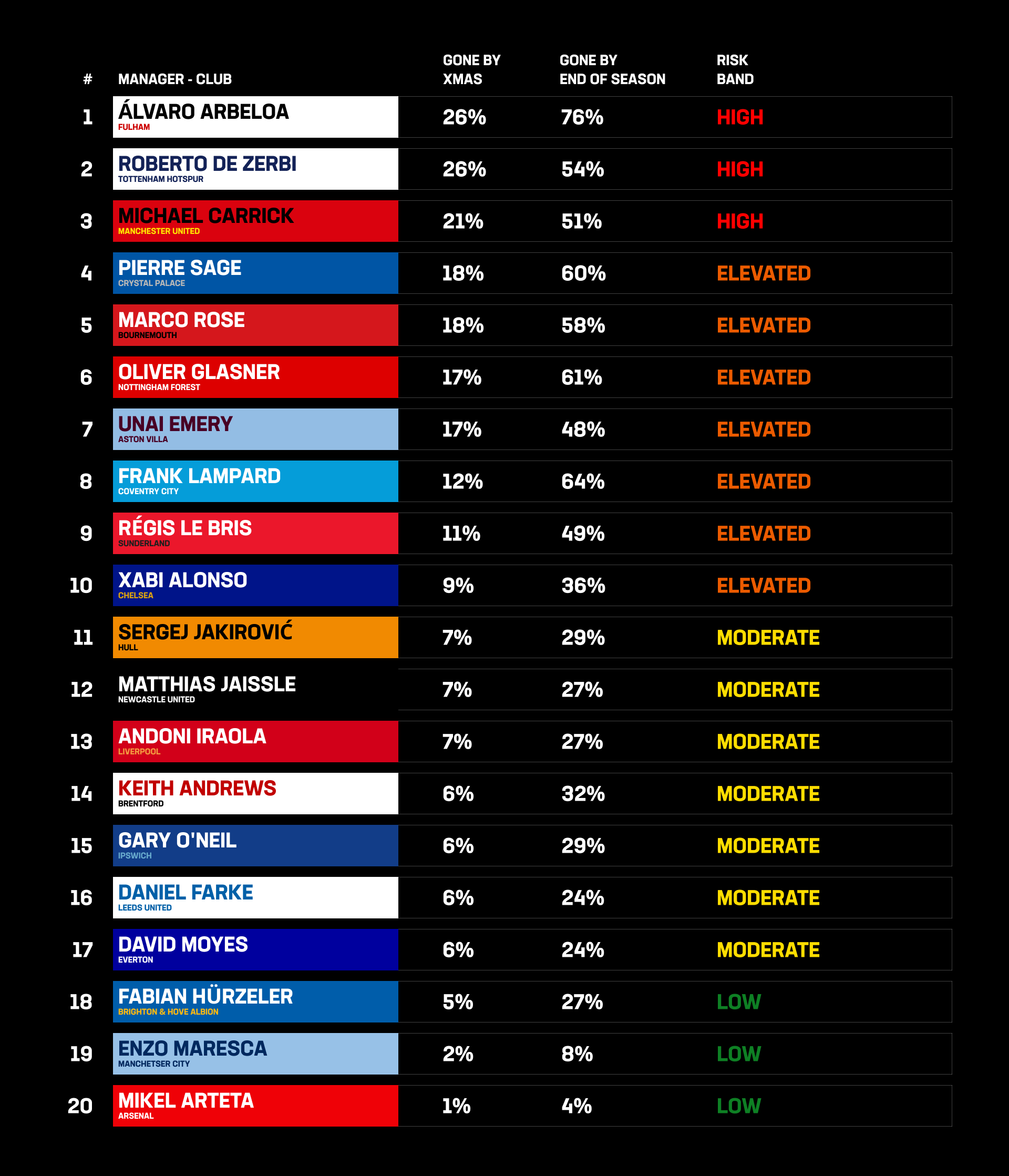
Chance of leaving by sacking or mutual consent. Model built on every Premier League managerial spell since 2006. Last updated 21 September 2026.
Top Stats
57 games the average Premier League manager lasts before the sack
40% of all sackings happen between November and January
17th the average league position of a sacked manager. Not 20th.
5 managers currently more likely to leave than stay

The most at risk
Álvaro Arbeloa, Fulham - 26% by Christmas, 76% by May
Two points from five, 19th, and no win yet. He replaced a manager who averaged 1.35 points a game across five seasons at Craven Cottage; Arbeloa is on 0.40. That comparison matters more than people think, the model finds that how you measure against the man before you is nearly as strong a predictor as your own form, and nobody in the league is further below their predecessor's benchmark. Fulham have sacked six managers in 15 Premier League seasons, and the typical Fulham sacking arrives after 19 league games. Arbeloa has played five. The model has him crossing the 50-50 line at around his 18th match in charge.
Roberto De Zerbi, Tottenham Hotspur - 26% by Christmas, 54% by May
Five games, two points, bottom of the league going into the international break and only two goals scored. Spurs have sacked 12 managers in 21 Premier League seasons, more than anyone outside Chelsea. His 26% by Christmas is the joint highest in the league with Arbeloa, and that near-term figure is the one to watch: his season number (54%) is also one of the highest, De Zerbi would need to turn things around soon, or the data suggests he will be inline for the first sacking of the season in the Premier League.
Michael Carrick, Manchester United - 21% by Christmas, 51% by May
Five points from five and 12th place is not what Old Trafford wants, based on a tough start to the season, a shaky back four & european football to contend with, the model predicts a rough time for Carrick this season. Manchester United’s track record of manager sackings since Ferguson will mean Carrick needs to turn it around quickly or face growing pressure from fans, the media & the boardroom.
Pierre Sage, Crystal Palace - 18% by Christmas, 60% by May
Four points from five and a goalless draw at Leeds that stopped the bleeding without fixing anything. Palace have conceded 11 in five. He took over from a manager on 1.37 points a game, and Palace sackings come early - 22 games is the club median.
The safest
Nobody is coming for Mikel Arteta
Arteta is on 1% by Christmas and 4% by the end of the season, the lowest in the league by some way - even after losing at Brighton. Arsenal have sacked one manager in 21 Premier League seasons. Behind him. Top of the league Enzo Maresca (2% / 8%) is the most secure of the eleven managers appointed since January.
What 20 years of sackings tell us
The average manager gets 57 games
That's the median across 158 Premier League sackings since 2006, about a season and a half. Four in ten managers are gone inside a single season. Two in three don't make it through two.
The honeymoon is real, and it's short
In a manager's first eight games, sackings run at 0.4 per 100 matches, clubs almost never pull the trigger that early. From game 20 to game 38 the rate is 1.65 per 100, four times higher. The most dangerous period of a Premier League manager's career is the second half of his first season, once the excuses have run out and the fixtures he was hired to fix have come and gone.
December is sack month
29 of the 158 sackings came in December, more than any other month. November to January accounts for 40% of the total. Clubs wait for the fixture pile-up to tell them what they already suspect, then move in time for the January window.
Managers get sacked from 17th, not 20th
The median league position at the moment of dismissal is 17th. Only 39% of sacked managers were in the relegation zone. 13% were sacked from the top half, José Mourinho twice, plus Thomas Tuchel, Antonio Conte, Roberto Mancini and Ruben Amorim. You do not have to be bottom to be finished.
The average sacked manager was on 1.15 points a game
Over a full season that's 44 points, enough to stay up comfortably in most years. Sackings are not usually a response to disaster. They're a response to mediocrity that has gone on slightly too long.
Half of sacked managers were doing better than the man before them
Exactly half. Which tells you that "better than the last guy" is not a defence, and that clubs are usually measuring against the version of themselves they think they should be.
The new manager bounce is a myth
Across all 158 changes, the incoming manager's first ten games produced 0.02 points per game more than his predecessor's record. Two hundredths of a point. The bounce that everyone talks about does not show up in twenty years of data.
Money doesn't buy patience
This one surprised us. We put net transfer spend and the owner's personal history of sacking managers into the model, expecting both to matter. Neither does, once you account for form, they make no measurable difference to whether a manager survives. What decides it is your last ten games and how you compare to the man before you. Everything else is noise.
Some clubs sack, some don't
Sackings per Premier League season since 2006: Nottingham Forest 1.00 (five in five seasons), Chelsea 0.62, Leeds 0.60, Tottenham 0.57, Crystal Palace 0.43, Fulham 0.40. Arsenal have sacked one manager in 21 seasons. Where you manage changes your life expectancy as much as how you manage.
How the model works
How we did it
Every sacking since 2006. 274 permanent appointments, 158 departures by sacking or mutual consent, and around 15,000 individual manager-matches. Caretakers excluded. Survival analysis. The same statistical method used to model patient survival in medicine, applied to managers. It's the standard approach in the academic research on football dismissals, and it handles the awkward cases properly, a manager who resigns, gets poached, or is still in post hasn't been sacked, and the model treats him accordingly rather than throwing him away. A probability, not a prediction. The output is a chance, not a date. A manager on 27% is not being told he'll be sacked. He's being told that roughly one manager in four with his form, at his club, at his stage of a spell, has been sacked within that window over the last twenty years. No bookmaker odds. We didn't use them. They'd make the model look better and tell you less.
Methodology box
The Sack Race model is a Cox proportional-hazards survival model with time-varying covariates, fitted to every permanent Premier League managerial spell from 2006-07 to the present. The inputs are a manager's form over his last ten league games, his points per game relative to his predecessor, current league position, the club's historical sacking rate, the owner's record of sackings at that club, net transfer spend in his first season (Transfermarkt) and the average strength of his next ten opponents. We tested it by training on seasons up to 2022-23 and predicting the three seasons after that, which the model had never seen. Assessed ten games into a season, it ranked the manager who went on to be sacked above the one who didn't 89% of the time. Assessed before a ball is kicked, that figure falls to 74%, there simply isn't much to go on in August. Data sources: Wikipedia season records for appointment dates, departure dates and manner of departure; engsoccerdata and openfootball for results; Transfermarkt for transfer spend; public records for club ownership. Historical figures cover 2006-07 to 2025-26. Managers who left after their club was relegated are counted as leaving, not as sacked. Last updated: 15 September 2026, after matchday 4. Next update: [21 September 2026], or within 24 hours of any Premier League managerial change.
Last updated: 21 September 2026, after matchday 4